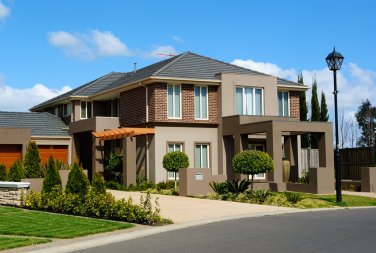
Average House Size in Australia (2026): A Complete Guide
When it comes to building and selecting a home, how you size your rooms is far more important than the final square metre figure on paper. Australian home sizes can seem generous in total area, but feel tight if rooms are poorly arranged. Day-to-day comfort relies less on how it looks and more on how well the space accommodates furniture, movement and actual use. This guide breaks down in detail the sizing of different corners of your home.
How House Size Is Measured in Australia
Two commonly used methods of measuring the size of a house in Australia are as follows:
- Internal liveable area: It includes spaces used for everyday living, such as bedrooms, living rooms, kitchens, bathrooms, and hallways.
- Total built-up area: This one is wider. It frequently incorporates garages, alfresco areas, balconies, verandahs and even storage spaces.
This difference can be misleading. It may look big in a listing, but be less efficient than you thought. Garages and outdoor spaces are a value addition, but they do not prove as valuable as functional internal rooms.
What’s more important is usable space, meaning the space you will actually occupy, because it determines comfort, furniture placement, and ease of movement. When comparing average room sizes of homes or planning a home extension Perth, focusing on internal liveable areas provides a clearer picture of how the house will actually feel day to day.
Average Size of Different Parts of the Home
Looking at individual spaces gives a far clearer picture of how a home functions than focusing only on total square metres. Each room has specific requirements for furniture, fixtures, and movement. If these are ignored, even a large house can feel cramped. Below is a breakdown of the average home size in Australia based on the different corners of the property:
Living Room
The living room is the primary shared space in most homes. It needs to comfortably accommodate seating, media units, and clear walkways. Poor sizing often leads to blocked circulation or furniture pushed too close together. If you want to add cabinets or storage spaces in your living room, you should contact professionals offering residential carpentry services in Australia.
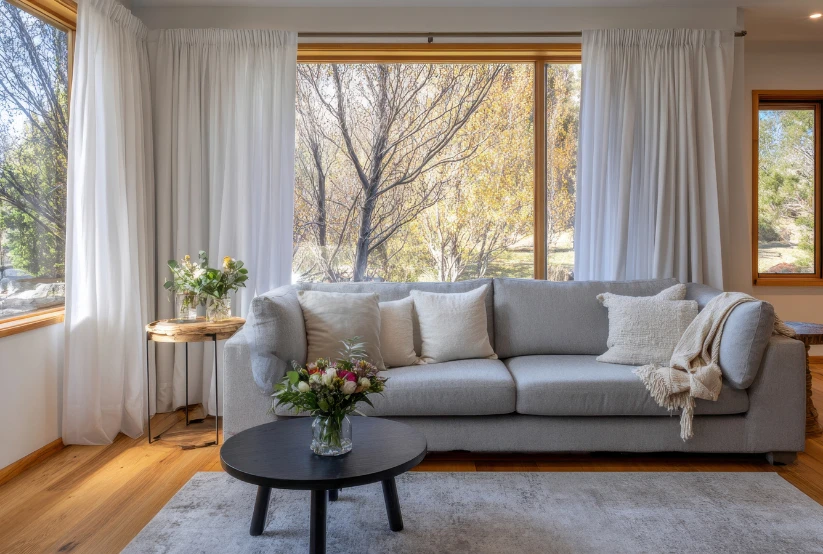
Average living room size: 20–35 m²
| Element | Average Size / Dimension | Notes |
| Living room area | 20–35 m² | Smaller homes sit closer to 20–25 m². Larger homes exceed 30 m². |
| Sofa (3-seater) | 2.0–2.4 m wide | Allow at least 900 mm circulation in front. |
| Armchairs | 800–900 mm wide each | Space 750–900 mm between seating pieces. |
| Coffee table | 1.0–1.4 m long | Leave 400–450 mm between sofa and table. |
| TV unit | 1.5–2.2 m wide | Depends on TV size and storage needs. |
| Walkway clearance | Minimum 900 mm | Required for comfortable movement. |
Bedroom
The Australian bedroom size dimensions must balance sleeping space with storage and movement. Master bedrooms require more space due to wardrobes and often an ensuite. Secondary bedrooms can be smaller, but should still allow easy circulation.
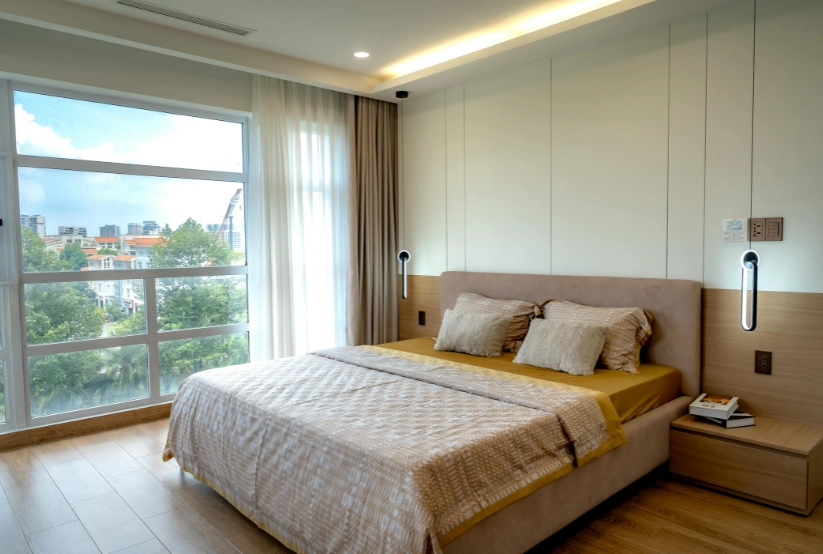
Average bedroom sizes in Australia:
- Master bedroom: 14–18 m²
- Secondary bedroom: 9–12 m²
| Element | Average Size / Dimension | Notes |
| Master bedroom area | 14–18 m² | Allows queen or king beds with storage. |
| Secondary bedroom area | 9–12 m² | Suitable for single or double bed. |
| Queen bed | 1.53 × 2.03 m | Minimum 750 mm clearance on sides. |
| King bed | 1.83 × 2.03 m | Needs wider circulation space. |
| Wardrobe depth | 600 mm | Standard for hanging clothes. |
| Bedside tables | 450–550 mm wide | Allow 750 mm walking space beside bed. |
Kitchen
The kitchen is one of the most space-sensitive areas of a home. Choosing the right size of a kitchen ensures safe movement, functional work zones, and space for appliances. Kitchen layouts vary greatly depending on whether an island or dining integration is included. You can always seek guidance from experts for kitchen renovations Perth or any other area to change the layout for better space efficiency.
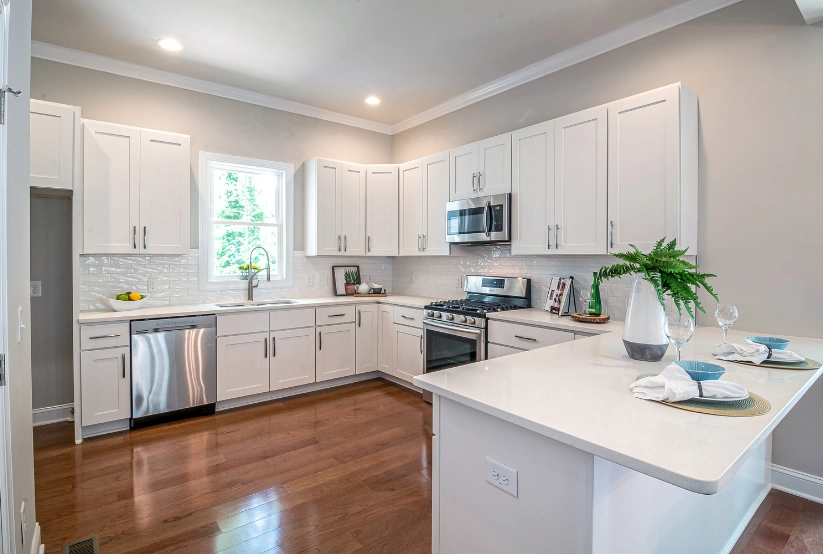
Average size dimensions of a kitchen in Australia: 10–20 m²
| Element | Average Size / Dimension | Notes |
| Kitchen area | 10–20 m² | A compact Australian kitchen size starts at 10–12 m². |
| Standard kitchen cabinet sizes | 500-600 mm | Standard depth for storage and appliances. |
| Overhead cabinets depth | 300–350 mm | Keeps head clearance comfortable. |
| Benchtop height | 900 mm | Standard ergonomic height. |
| Kitchen island | 1.8–2.4 m long | Requires clearance on all sides. |
| Clearance around island | 1,000–1,200 mm | Essential for multiple users and appliances. |
| Dining table (if included) | 1.4–1.8 m long | Needs 900 mm clearance around. |
Bathroom
Deciding on the right Australian bathroom size requires careful planning to fit fixtures without compromising comfort. Even minor changes like adding a small bath vanity can significantly affect usability. Storage and ventilation should also be considered. Always call bathroom renovation experts if you want to make any alterations or additions to the bathroom space.
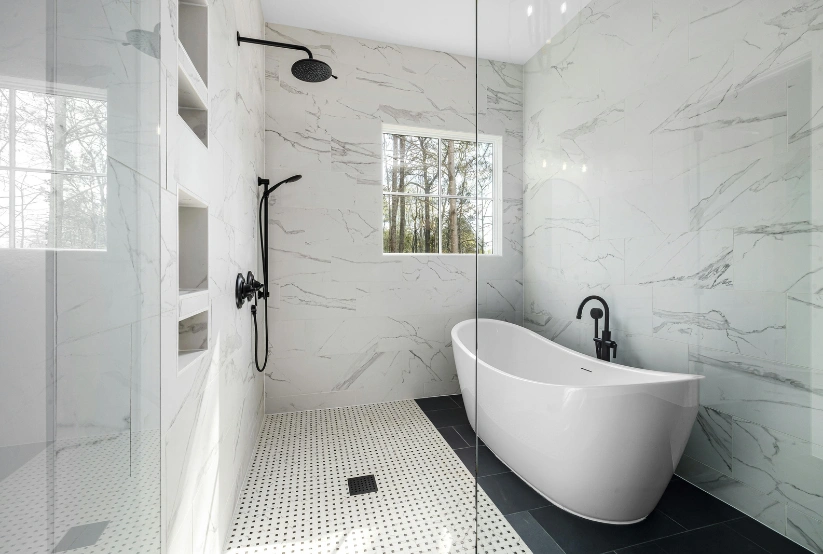
Average bathroom size in Australia: 4–8 m²
| Element | Average Size / Dimension | Notes |
| Bathroom area | 4–8 m² | Ensuites are usually at the lower end. |
| Shower | 900 × 900 mm | Minimum comfortable shower size. |
| Bathtub | 1.5–1.7 m long | The standard bathtub size in Australia leaves clear access on one side. |
| Vanity | 750–1,200 mm wide | Depends on single or double basin. |
| Toilet clearance | 750 mm front clearance | Improves comfort and accessibility. |
| Door clearance | 820 mm door width | Standard for residential bathrooms. |
Dining Area
Dining areas may be separate or combined with kitchens or living spaces. The key requirement is enough space to move chairs freely without obstructing walkways. Experts who offer home designing & drafting services can help you design the dining area perfectly.
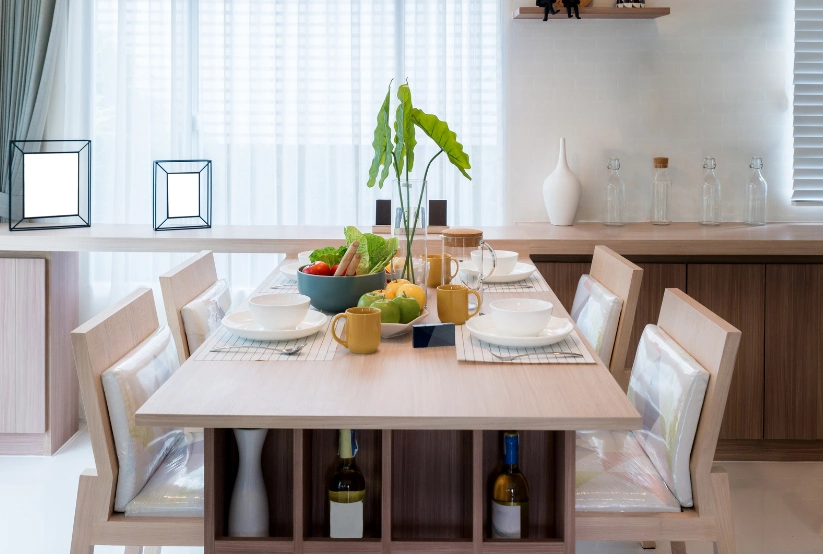
Average dining area size: 8–15 m²
| Element | Average Size / Dimension | Notes |
| Dining area | 8–15 m² | Open-plan homes usually sit at the higher end. |
| 4-seater table | 1.2–1.4 m long | Suitable for smaller households. |
| 6-seater table | 1.6–1.8 m long | Most common in family homes. |
| Chair clearance | 900 mm | Required behind each chair. |
| Walkway space | Minimum 1,000 mm | Prevents crowding during use. |
Outdoor Area
Outdoor spaces are an important part of Australian homes. They support entertaining, relaxation, and family activities. Alfresco areas should be sized to function like an extension of indoor living.
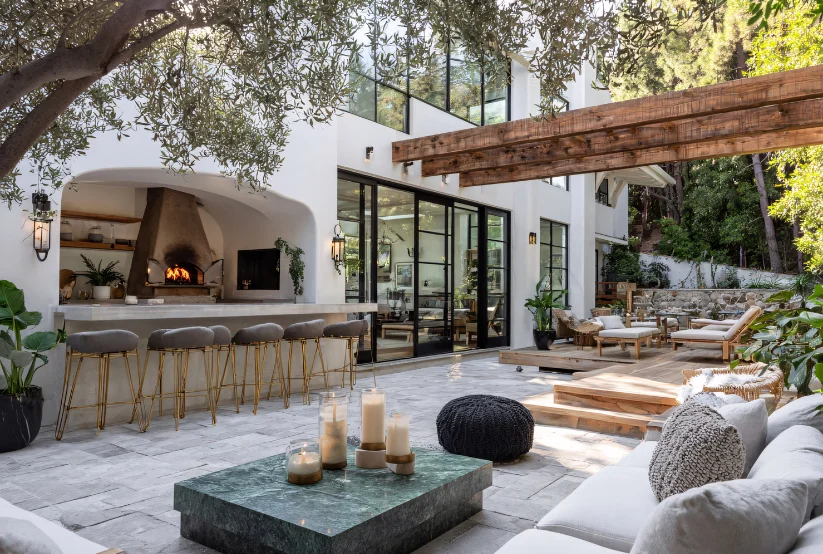
Average outdoor area size: 10–25 m²
| Element | Average Size / Dimension | Notes |
| Alfresco area | 10–25 m² | Larger homes exceed 20 m². |
| Outdoor dining table | 1.6–2.2 m long | Similar sizing to indoor tables. |
| BBQ unit | 600–900 mm wide | Allow prep space on at least one side. |
| Seating lounge set | 2.5–3.5 m wide | Depends on layout and seating capacity. |
| Circulation space | Minimum 1,000 mm | Required for safe and easy movement. |
Total House Size Calculation Based on Room Allocation
Calculating total house size works best when it is built up from individual room allocations rather than a single headline number. Each space contributes differently to comfort, movement, and daily usability. When living areas, bedrooms, service spaces, and outdoor zones are sized within practical ranges, the overall house feels balanced. Confused about the correct dimensions for your new build or renovation? Contact the best professionals for home renovation services Perth or any other part of Australia.
| Area | Small Home Range | Medium Home Range | Large Home Range |
| Living room | 18–24 m² | 25–32 m² | 33–40 m² |
| Bedroom(s) | 18–26 m² | 30–42 m² | 45–60 m² |
| Kitchen | 9–12 m² | 13–18 m² | 18–25 m² |
| Bathroom(s) | 6–10 m² | 10–16 m² | 16–24 m² |
| Dining area | 7–10 m² | 10–15 m² | 15–20 m² |
| Outdoor area | 8–15 m² | 15–25 m² | 25–35 m² |
| Subtotal of key spaces | 66–97 m² | 103–148 m² | 152–204 m² |
| Circulation and storage | 12–18 m² | 18–25 m² | 25–35 m² |
| Estimated total house size | 78–115 m² | 121–173 m² | 177–239 m² |
Average House Sizes by Bedroom Count
Bedroom count gives a broad idea of house size, but true comfort depends on how space is distributed across living areas, bathrooms, storage, and circulation. As bedrooms increase, homes usually add extra bathrooms, larger kitchens, and additional living zones. Outdoor areas also expand to support family use and entertainment. The table below expands on typical size ranges by bedroom count and shows how internal liveable space and outdoor areas scale together in well-planned Australian homes.
| Bedroom Count | Living Areas (Typical) | Bathrooms (Typical) | Outdoor Area Range | Average Total House Size Range |
| Average 1 bedroom house size m2 Australia | Single combined living and dining | 1 bathroom | 8–15 m² | 70–100 m² |
| Average 2 bedroom house size m2 Australia | Open-plan living and dining | 1–2 bathrooms | 10–20 m² | 100–140 m² |
| Average 3 bedroom house size m2 Australia | Main living plus optional second lounge | 2 bathrooms | 15–30 m² | 140–190 m² |
| Average 4 bedroom house size m2 Australia | Two living areas | 2–3 bathrooms | 20–40 m² | 190–260 m² |
| Average 5 bedroom house size m2 Australia | Multiple living zones | 3+ bathrooms | 30–60 m² | 260–350 m² |
Average House Size in Perth
Homes in Perth tend to prioritise wider layouts, stronger indoor–outdoor connections, and practical room proportions. Block sizes are often more generous compared to denser eastern cities, which allows rooms to feel broader rather than taller or stacked. Living areas and outdoor spaces usually receive more emphasis, while kitchens are designed for everyday family use and entertaining. The size ranges below reflect common planning patterns seen in Perth homes in 2026, focusing on usability rather than headline square metres.
| Area | Typical Size Range | Common Inclusions | Planning Notes |
| Living room | 25–40 m² | Main seating zone, TV unit, occasional chairs | Perth living rooms are often wider to support open-plan layouts and airflow. |
| Bedroom (main) | 15–20 m² | Queen or king bed, wardrobes, bedside tables | Master bedrooms are usually larger, often planned with space for future ensuite access. |
| Bedroom (secondary) | 10–14 m² | Single or double bed, wardrobe | Designed to suit children, guests, or home offices. |
| Kitchen | 14–22 m² | Base cabinets, overhead cabinets, island bench | A typical kitchen size in Perth will include enough space for islands. |
| Bathroom | 5–9 m² | Shower, vanity, toilet, optional bath | Ensuites sit at the lower end of the range. |
| Dining area | 10–18 m² | 6–8 seater dining table | Often integrated with kitchen and living zones. |
| Outdoor area | 20–45 m² | Alfresco dining, BBQ, seating | Outdoor living is a strong priority in Perth homes. |
House Size Trends in Australia in 2026
House size trends in 2026 show a clear shift away from simply building bigger homes. The focus has moved towards smarter space planning and better room usability, especially for tiny house dimensions. Rising construction costs and changing household needs have pushed homeowners and builders to prioritise efficient layouts over excess square metres.
Well-designed homes now feel spacious without being oversized. Gen Z buyers, in particular, are influencing this shift by valuing flexibility, affordability, and design-led efficiency over sheer size. Key trends shaping house sizes in 2026 include:
- More efficient floor plans: Homes feature fewer wasted corridors and tighter circulation paths. Open layouts are carefully planned to avoid large but unused spaces.
- Balanced room proportions: Living rooms, kitchens, and bedrooms are sized to match actual daily use. Oversized feature rooms are being replaced with evenly distributed space.
- Growth of indoor–outdoor living: Outdoor areas remain important, but Gen Z-driven designs focus on compact alfresco spaces that function as true extensions of living zones.
- Flexible spaces over extra rooms: Instead of adding more bedrooms, homes include adaptable rooms that support work, content creation, study, or guest use.
- Design-led small homes: Gen Z preferences favour clean layouts, built-in storage, modular furniture, and minimalist aesthetics that make smaller homes feel open and intentional.
- Moderation in total house size: Average house sizes have stabilised. Compact and medium-sized homes dominate new builds, offering better affordability, lower running costs, and reduced environmental impact.
In 2026, every boutique home builder Perth reflects a practical approach to sizing. Comfort now comes from intelligent design, thoughtful room allocation, and layouts that support modern lifestyles rather than from sheer size alone.
Ending Note
Understanding house size begins with how each room is planned, not with a single square metre figure. When living spaces, bedrooms, kitchens, and outdoor areas are sized correctly, homes feel comfortable and functional at any scale. This room-first approach helps buyers and builders make better decisions. In the end, remember that the right home size will depend on your needs and preferences.
Disclaimer: All size ranges mentioned in this guide are approximate. Actual room and house sizes can vary based on design choices, local planning regulations, block dimensions, construction methods, and individual lifestyle needs.
FAQs – Frequently Asked Questions
How to decide the right size of a home in Australia?
Choose a home size based on household needs, lifestyle, and budget, keeping in mind the Australian average of 230–240 m² and long-term energy and maintenance costs.
What is the right size of a bedroom in Australia?
A Master bedroom is around 14–18 m², while Secondary bedroom are typically 9–12 m² or larger for comfort and storage.
What is the right size of a kitchen in Australia?
Most Australian kitchens range between 10–20 m², providing enough space for appliances, storage, and efficient movement.
How to decide the appropriate size of a bathroom in Australia?
A typical bathroom is 4–8 m², sized to comfortably fit required fixtures while allowing good ventilation and ease of use.
What is the right average home size in Australia?
The Australian homes average size is 230–240 m² and long-term energy and maintenance costs.